
The 5th of our 31 Dreamers is Rebecca, an amateur mushroom hunter from Bellingham, Washington. Rebecca sent me the following dream back in October and I thank her for waiting so patiently for an analysis. The dream:
I am outside in a garden.
I lift a brick and discover mycelium threads clinging to the brick.
I am surprised—the mycelium is Allen Ginsberg.
Small beautiful flower heads begin "fruiting" off the brick.
The flowers are his poem Kaddish.
I pick Allen's flower poem and begin to cut it up into a fine powder.
I snort it up my nose.
I think to myself what a beautiful gift.
I feel a deep love for Allen as mushroom and his flower poem Kaddish.
Then I start thinking in Yiddish.
(Sidenote: Kaddish is a poem Ginsberg wrote about his mother. It's a heavy poem.)
Beautiful dream Rebecca. So beautiful that I'm tempted to just leave it be. My expounding upon it will only break the spell of its poetry. I invite anyone reading this to stop here—to move on and turn to the dreams of others or, better yet, send in a dream of their own. The curious may proceed, for this dream packs in a rich loam of subject matter as well as cultural and mycological references that I must unpack a little bit. First the mycology:
Myceliae (plural of mycelium) are basically the "roots" of a fungus. They can range in size from microscopic threads to massive subterranean rhizomorphs that spread for miles. The world's largest known organism is an Armillaria ostoyae (the honey mushroom) in eastern Oregon whose myceliae span over 2,000 acres.
Fruiting bodies (pictured above) are like "flowers"— the fleshy, spore-producing parts of the fungus that poke up out of trees, logs and soil—the portion of the fungus that we generally refer to as "mushrooms."
Next, the (human) culture:
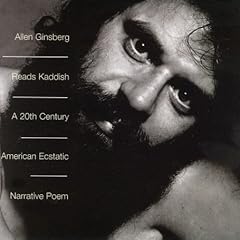 When poet Allen Ginsberg's mother died in 1956, the rabbi would not deliver the Mourner's Kaddish prayer at her funeral in the presence of Ginsberg's beatnik goyim friends. The poem Kaddish (our book of the day) is what he wrote in lieu of that—a memorial to his mother written in fits and starts while tripping on hallucinogenics, amphetamines, and (gasp!) jazz. It is as much a portrait of the Beat poet as it was of the woman who birthed him.
Rebecca, I take it you know all this. I'm just putting on the record for the rest of us. In your dream you look for something and you find it. You flip over a brick and there it is. It feeds you with beauty and knowledge and the process is so simple and direct, yet there is complexity in it. You crush this "heavy poem" into dust and shoot it up into your brain, but the reality is Kaddish isn't so easy to digest, nor is Yiddish so easy to learn—no language is! And yet you master both in one quick sniff. Ah, if only it were that easy when we're awake!
This dream is rife with cycles of birth, growth and death. Music composer John Cage—a practicing Buddhist, amateur mycologist and contemporary of Ginsberg's—wrote a lot about mushroom hunting and cuisine. In the final passage of his groundbreaking work Indeterminacy (1959), Cage tells of meeting a Buddhist art historian from Philadelphia who asks him about the symbolism in the Buddha's death from eating a mushroom. Cage writes:

I explained that I’d never been interested in symbolism; that I preferred just taking things as themselves, not as standing for other things. But then a few days later while rambling in the woods I got to thinking. I recalled the Indian concept of the relation of life and the seasons. Spring is Creation. Summer is Preservation. Fall is Destruction. Winter is Quiescence. Mushrooms grow most vigorously in the fall, the period of destruction, and the function of many of them is to bring about the final decay of rotting material. In fact, as I read somewhere, the world would be an impassible heap of old rubbish were it not for mushrooms and their capacity to get rid of it. So I wrote to the lady in Philadelphia. I said, “The function of mushrooms is to rid the world of old rubbish. The Buddha died a natural death.”
The life cycle of the mushroom parallels that of Allen Ginsberg and his mother: The young Yiddish-speaking Mrs. Ginsberg came to America, had to a son, Allen, and eventually died. Allen, in turn, birthed his poems, and he too died one day. For you, Recbecca, dreaming your dream last fall, "the period of destruction" when "mushrooms grow most vigorously" (and when, I presume, you do the bulk of your mushroom hunting) you dreamt of the poet as mycelium threads, taking the remains of his mother's life and turning it into a poem, which you in turn absorbed to gain the original knowledge that his mother possessed: the Yiddish language.
What does this dream say about the way you want to process other things? Take your own mother, just as an example—are there things that you'd like to know from her that, for whatever reason, are difficult to obtain? Would it be easier to simply write a poem about her when she's gone, grind it up, snort it up your nose and BANG!—everything you wanted to glean from your mom's mind is there without the parts you don't want—you know, the difficult parts that are painful to digest? I know I'd sometimes like to do this with regards to my own mother, among others. Sometimes.
In reality we have to deal with people holistically. We can't just suck the Yiddish from their brains and leave the rest to decay under the bricks in the garden. This is what your dream challenges you to do: to take Kaddish and the mothers of the world in all their beautiful and difficult entirety, for better and for worse, and realize the love presented in the whole picture. Only then will you unearth the truth that you seek.


 Posts
Posts


